From Point-in-Time Audits to Continuous Assurance with OSCAL and RegO
How RegO turns compliance data into continuous assurance, from point-in-time audit preparation to an always-current, evidence-driven compliance operating model.
Key Takeaways
- OSCAL is a machine-readable language for representing controls, system implementations, assessments, findings, risks, and remediation.
- OSCAL creates the data foundation for continuous compliance, but operational monitoring, evidence collection, workflow, and reporting are still required.
- RegO operationalizes the OSCAL lifecycle across Catalogs, Profiles, SSPs, assessments, findings, POA&Ms, remediation, and assurance reporting.
- Together, OSCAL and RegO replace fragmented documents and point-in-time checks with a connected and continuously updated compliance model.
Why Point-in-Time Compliance Is No Longer Enough
Traditional compliance programs are often organized around an audit calendar. Teams update policies, collect screenshots, export reports, reconcile spreadsheets, and assemble evidence shortly before an assessment. Once the audit is complete, the documentation begins to age while systems, applications, identities, cloud resources, vulnerabilities, and configurations continue to change.
This creates a gap between the compliance record and the actual operating environment. A control that passed three months ago may no longer be effective today, and a new resource or configuration change may never appear in the approved documentation.
Continuous compliance requires a common model that connects requirements, implementation, evidence, findings, risk, remediation, and reassessment.
What Is OSCAL?
The Open Security Controls Assessment Language (OSCAL) is a NIST-led initiative that represents security and compliance information in machine-readable formats such as JSON, XML, and YAML. It is not another control framework. It is a standardized language for expressing and exchanging compliance information throughout the lifecycle.
OSCAL can represent:
- Control catalogs and tailored baselines
- Relationships between frameworks
- Reusable component implementations and System Security Plans (SSPs)
- Assessment plans, evidence, observations, and findings
- Risks, Plans of Action and Milestones (POA&Ms), and remediation status
| Layer | Core Question | Key Models |
|---|---|---|
| Control | What must be satisfied? | Catalog, Profile, Control Mapping |
| Implementation | How is it implemented? | Component Definition, SSP |
| Assessment | Is it effective, and what must be corrected? | Assessment Plan, Assessment Results, POA&M |
These models build on one another: a Profile selects applicable controls, the SSP describes how the system implements them, the Assessment Plan defines how they will be evaluated, Assessment Results capture evidence and findings, and the POA&M tracks corrective action.
OSCAL Provides the Foundation, Not the Entire Operating Model
OSCAL standardizes compliance data, but it does not by itself monitor infrastructure, query security tools, detect configuration drift, assign findings, manage remediation, or generate executive assurance views. An organization can convert a Word-based SSP into OSCAL and still remain dependent on periodic, manual processes.
Continuous compliance therefore requires OSCAL to be connected with cloud platforms, asset inventories, vulnerability scanners, IAM, SIEM, DevOps, configuration tools, ITSM, evidence repositories, and reporting workflows.
OSCAL defines how compliance information is represented. RegO operationalizes how that information is maintained, assessed, and acted upon.
How RegO Operationalizes OSCAL
Connects the Complete OSCAL Lifecycle
- The challenge
- Organizations often stop at a Catalog or SSP, leaving assessment, evidence, findings, and remediation in separate systems.
- How RegO helps
- RegO manages Catalogs, Profiles, SSPs, Assessment Plans, Assessment Results, Findings, POA&Ms, remediation, and exports as one connected lifecycle.
Maintains a Living SSP
- The challenge
- Static SSPs quickly fall behind changes in applications, infrastructure, ownership, and architecture.
- How RegO helps
- RegO uses asset discovery, CMDB synchronization, dependency mapping, and controlled workflows to keep inventories, control implementations, and SSP information current.
Automates and Reuses Evidence
- The challenge
- Teams repeatedly collect the same screenshots, reports, access lists, and configuration records for different reviews.
- How RegO helps
- RegO collects evidence from infrastructure, cloud, security tools, and applications, preserves its context and provenance, and makes it reusable across assessments and audits.
Detects Drift and Control Failure Earlier
- The challenge
- Point-in-time assessments cannot show whether a compliant configuration later changes or a new resource appears outside the approved baseline.
- How RegO helps
- RegO continuously validates applicable technical controls, detects compliance drift, records trends, and alerts responsible teams when deviations occur.
Connects Vulnerabilities, Findings, and Remediation
- The challenge
- Vulnerability and compliance processes are frequently separated, while findings lose control and risk context when they move into ticketing tools.
- How RegO helps
- RegO links vulnerabilities and findings to affected controls, systems, business services, risks, owners, SLAs, POA&Ms, and reassessment results, creating a closed remediation loop.
Provides Enterprise and Executive Visibility
- The challenge
- Control spreadsheets and raw technical dashboards do not explain where the organization is exposed or whether risk is improving.
- How RegO helps
- RegO provides compliance scores, trends, risk heat maps, application and business-unit views, AI-driven insights, and traceable reporting for executives, auditors, and operational teams.
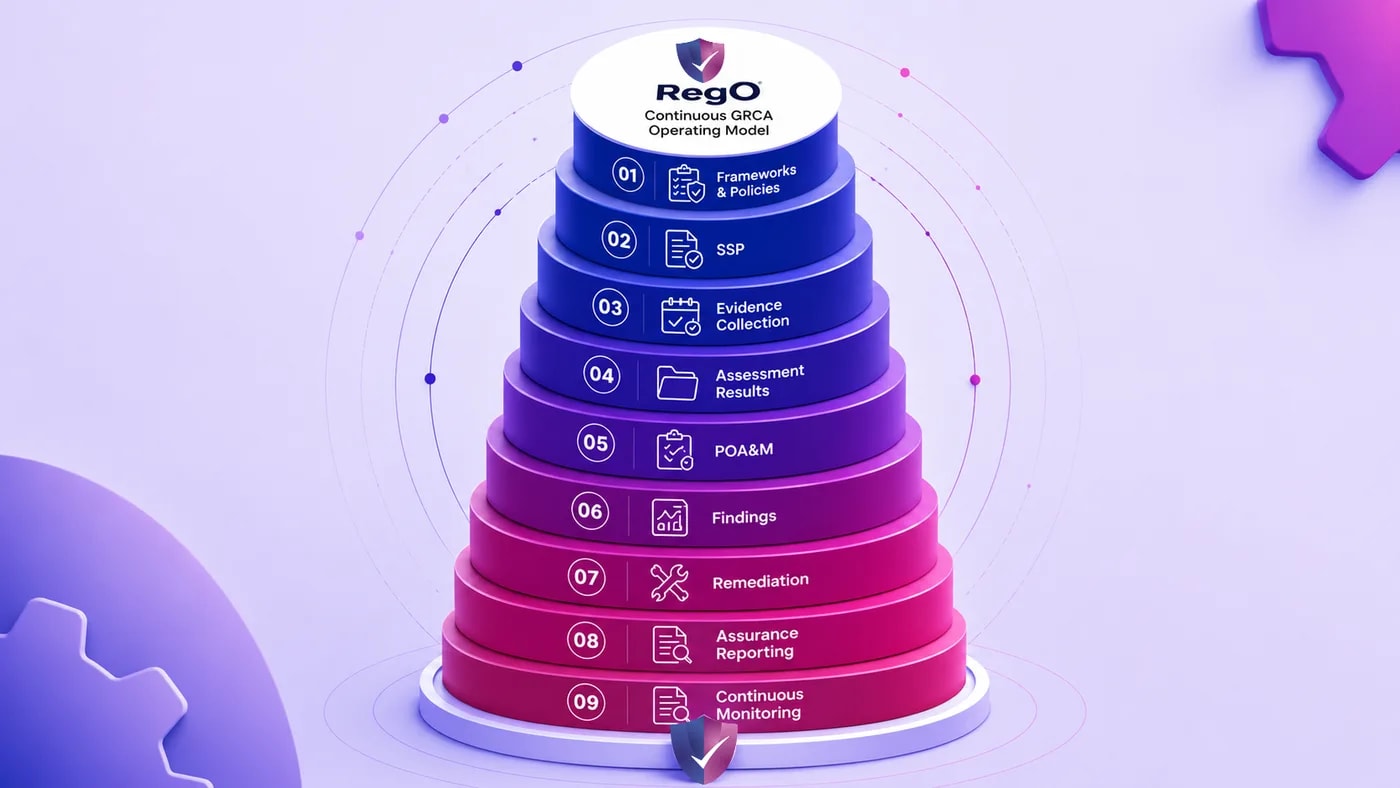
The RegO Continuous GRCA Operating Model
RegO connects governance, risk, compliance, and assurance into a continuous workflow, from the applicable framework to evidence, findings, corrective action, and reporting.
The process becomes continuous because remediation changes the environment, reassessment verifies the result, and the new evidence updates the organization's assurance position.
From Machine-Readable Compliance to Continuous Assurance
OSCAL connects requirements, implementations, assessments, evidence, findings, and remediation through a standardized data model. RegO adds the operational capabilities needed to keep that data current: asset discovery, evidence collection, continuous control validation, risk-based prioritization, remediation workflow, and assurance reporting.
From documents to structured data. From periodic evidence to continuous validation. From isolated findings to accountable remediation. From point-in-time compliance to continuous assurance.
Business Value of Continuous Compliance
By combining machine-readable compliance data with continuous monitoring and workflow automation, RegO helps organizations reduce repetitive effort and improve audit readiness. Indicative outcomes presented for the platform include:
Actual results depend on integration coverage, the percentage of controls suitable for automation, data quality, system scope, and organizational adoption.
Frequently Asked Questions
Is OSCAL a compliance framework?
No. OSCAL is a standardized language and set of data models for representing control-based compliance information.
Does OSCAL automatically make a system compliant?
No. Controls must still be implemented, assessed, and remediated. OSCAL provides the structure for exchanging and tracing that information.
What is the difference between OSCAL and RegO?
OSCAL defines the data model. RegO uses that model to operate continuous monitoring, evidence collection, assessments, findings, POA&Ms, remediation, dashboards, and reporting.
Does continuous compliance mean every control is monitored continuously?
No. Technical controls may support frequent automated checks, while policy, governance, and process controls may still require periodic human assessment.
Can RegO support restricted environments?
RegO is designed to support on-premises and air-gapped deployment for regulated organizations.